There are three main types of reality: objective reality, which is measurable and exists independently of human perception; subjective reality, which is shaped by individual experiences and beliefs; and intersubjective reality, which exists through collective agreement among people. Understanding these distinctions and using them properly is advantageous and can help clarify how we perceive and interact with the world.
Confusing the three types causes misunderstanding, emotional reactions and irrational thinking.
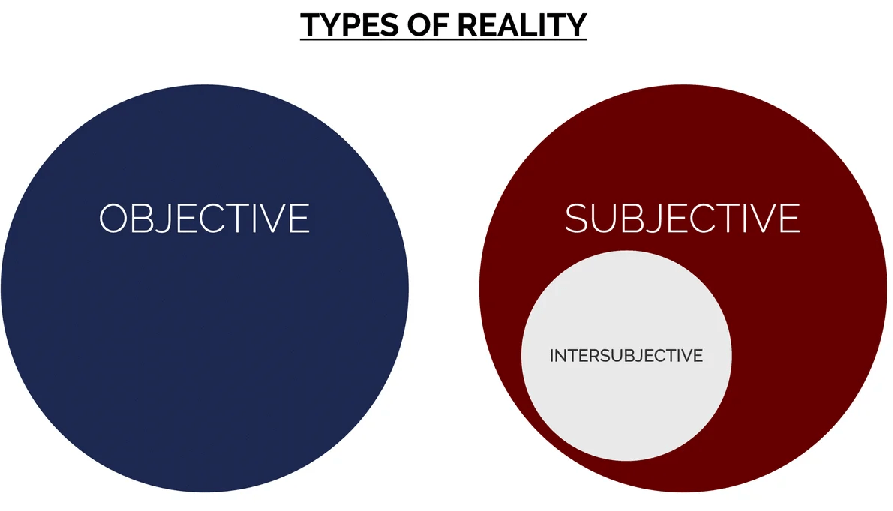
I do not believe that anyone is totally objective all the time. We are human beings, and designed by our Creator to be imperfect!
Our “reality” can shift moment-to-moment, day-by-day… it is not a fixed condition, and as such is subject to outside influences. Elemental and moderate social changes are to be expected. Those with a predominately objective evaluation of life, will recognize those changes, and modify, adapt and overcome – with varying degrees of success – those viscititudes.
Th e “homeless” sub-population are an excellent example. Those who have recently entered the community of the homeless, may modify and adjust by moving in with relatives. In their objective reality, they may believe the relatives glad to help them in their time of need. Food and shelter are the immediate, primary needs of all humans. They who are accepted by relatives or others, stand the best chance of restoring themselves to at least a modicum of thier reality.
Those who cannot, or choose not to involve relatives, will find their new environmental situation distressing, untenable… and the longer they remain in that sub-population, the greater the chance of mental illness! Approximately 67% of people experiencing homelessness have acquired, or brought with them, mental health disorders – perhaps due to their.loss of objective reality in their unfamiliar social environment. Schizophrenia finds a quick and easy home within the homeless encampments.
In a subjective reality, shaped by individual experiences and beliefs, life become more or less complex. The transgender community is an excellent example of a combination of subjective and intersubjective realities. Their subjective reality permits them to question thier birth determined sex… but feelings are emotional, and thereby less than reliable. Emotions are reactive-based, and can shift quickly depending on the stability of the situational environment. Nonetheless, the transgender individual has little objective reality, and is irrational regarding his/her/their actual sense of physical sex. This is accepted behavior throughout the transexual community. Where they make their mistake, is expecting the objective world to support their fantasy. The only people who may understandably question their sex, would be those who are born hermaphrodites, an organism that possesses both male and female reproductive organs, allowing it to produce both male and female gametes. This is uncommon in human beings,. -1.7% is a commonly cited estimate for intersex traits overall (about 1 in 60), but this includes a broad
range of conditions and may reflect traits that might not be noticed at birth in many people.), but not in the rest of the animal world and plants. Animal species in which individuals are either male or female are gonochoric, which is the opposite of hermaphroditic. Plant species in which individuals are either male or female are dioecious. The individuals of many taxonomic groups of animals, primarily invertebrates, are hermaphrodites, capable of producing viable gametes of both sexes. Atypical genitalia is not a disease; it’s a difference of sex development. Usually, atypical genitalia can be seen at or shortly after birth. The condition can be very distressing for families. Your medical team looks for the cause of atypical genitalia and provides information and counseling that can help guide decisions about your baby’s sex and any needed treatment. Hopfully, the deisred sex of the infant will be decided by the parental unit(s) in conference with the doctor(s) early in infancy, in order to minimize social problems for the chilld as it develops. For exampole, in kindergarten little “Johnny” suddenly appears one day as little “Joanie”. This is an instance which could follow the child throughout his/her life without corrective action.
In the intersubjective world, which exists through collective agreement among people, is undoubtly the basis of social norms. The world of the “normies” – who tend to agree on scientific facts – such as:
the Sun rises in the east and sets in the west, rain is wet, grass is green, unprovoked taking of a human life is forbidden, etc. The most powerful areas of disagreement among the normals are religion and politics, both of which are belief-based… which is where subjective reality enters the ‘stage of life’.
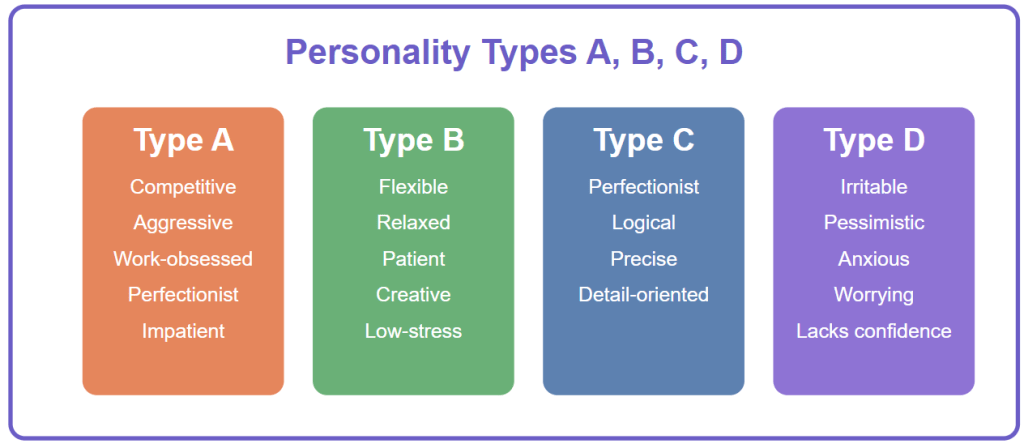
We should all expect to primarily engage in one of the three types of reality, but allow ourselves to access and be aware of the presence of the other two types. When understood – and kept in balance – one’s life – overall – should be fairly simple and pleasant. The deciding factor will be your personality type.
Type A personalities are ambitious, competitive, and often impatient (in a group of alphas there will usually be at least an almost palpable tension, because each the individuals believe they should be the leader)., while Type B personalities are more easygoing and relaxed. Type C personalities tend to be detail-oriented and introverted, and Type D personalities are characterized by negative emotions and social inhibition.
BUT… that’s a discussion for another time! À bientôt mes amies!!



Leave a Reply