WHAT EXACTILY ARE PERSONALITY TRAITS?
The Big Five theory suggests that personality can be described through five broad dimensions:
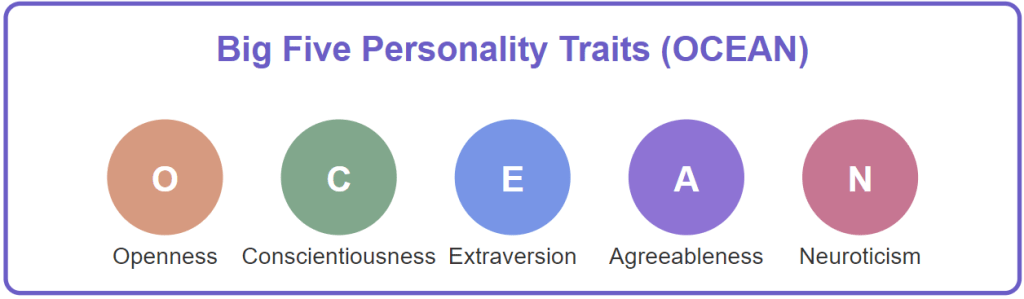
Openness to Experience: Involves curiosity, creativity, and openness to new ideas. High scorers are imaginative and adventurous; low scorers prefer routine and practicality.
Conscientiousness: Reflects self-discipline, organization, and reliability. High scorers are responsible and goal-oriented; low scorers may be more spontaneous and less organized.
Extraversion: Describes sociability, assertiveness, and energy. High scorers are outgoing and thrive on social interaction; low scorers tend to be more reserved and quiet.
Agreeableness: Involves kindness, empathy, and cooperation. High scorers are compassionate and value harmony; low scorers may be more competitive or blunt.
Neuroticism: Measures emotional stability and sensitivity to stress. High scorers are more anxious and prone to mood swings; low scorers tend to be calm and resilient.
Each trait exists on a continuum, and most people fall somewhere between the high and low ends for each dimension.
We are all different. While some people are naturally outgoing and talkative, others are quiet and reserved. Some are adventurous and love trying new things, while others prefer routine and predictability.
One theory suggests that personality can be categorized into A, B, C, and D.
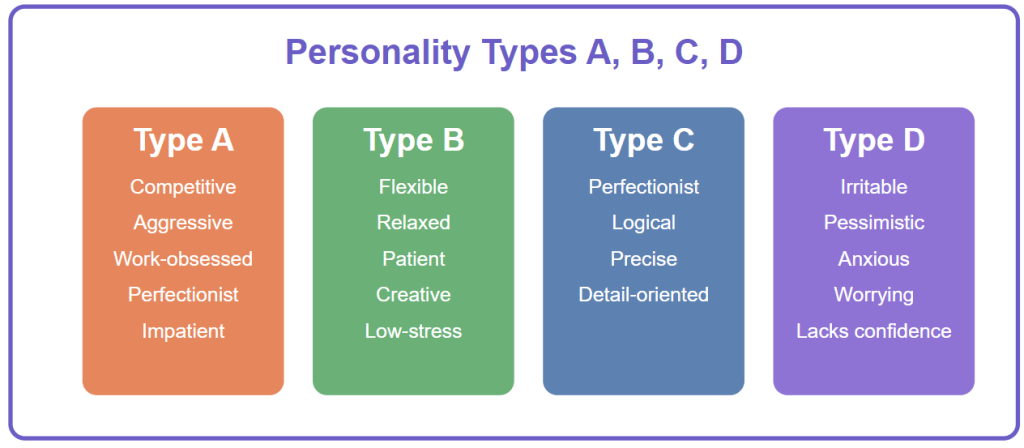
Type A: Competitive, aggressive, work-obsessed, hostile, impatient, perfectionist, stressed. This is where most people in superviory or control are inclined toward. CEO’s, COOs’, CFO’s, and HR, shift supervisors, career Military and Law Enforcement. Creators of things and services – Abraham Lincoln, Thomas Edison and Elon Musk and doctors are prime examples of Alpha Personalities. Politicians in general, tend toward the Type A personality. The Type A personality is driven toward control and leadership positions, and during that search they may be less-than-trustworthy to others, because they will do anything to acheive their goals!
Type B: Flexible, relaxed, patient, creative, even-tempered, low-stress, prone to procrastination. Counselors/Psychologists, Public Relations, Clergy, Lawyers and labor superviors tend to be Type B personalities.
Type C: Perfectionist, logical, more precise, detail-oriented. This is the environment of Mechanics, Physicists, Surgeons, Architects, and Engineers.
Type D: Irritable, pessimistic, anxious, hopeless, worrying, sad, gloomy, lacks self-confidence. This category type tends to include those who have never developed social and/or marketable work skills. The most noteworthy charateristic of the Type D, is that they are irritants to Type A-C, and they tend to distract others with their misery, Most likely undereducated, frequently unemployed, and recipients of Welfare support.
I seriously doubt that anyone is a full-time fixed type. We tend to shift types when there is a change in our environment. A lothario is essentially an actor, and most likely to have access to both Type A and Type B personalities, and will shift back and forth as the perceived need dictates. We all tend to observe our working/social environments, and may reactively make small adjustments through all of the four personality types as any significant changes are percieved.
PERSONALITY DEVELOPMENT – WHERE DOES PERSONALITY COME FROM?
Some of the biggest questions in personality psychology have something to do with how individuals develop personalities and how much of someone’s personality changes throughout their lives.
Theorists, such as Sigmund Freud, beleived personality to be static, already developed at a young age. However, due to modern personality research, we now know that personality can change over time. So, while the broad traits may remain constant, a person’s overall personality can change, particularly as they age.
According to research, people tend to show signs of maturity in personality test scores, especially emotional stability, as they age. Personality change can also occur due to exposure to different environmental factors or circumstances, such as divorce or becoming a parent. You can also try to deliberately alter some aspects of your personality characteristics by trying to behave differently.
PERSONALITY DISORDERS
Personality differences determine much more than self-image, including differences in health and well-being, personal success, and the quality of relationships. Even the risk of mortality is associated to some extent with the differences in personality traits.
Personality also interesects with mental health. A healthy personality allows one to manage the everyday stresses of life and develop and sustain satisfying relationships. That doesn’t mean we will not have a bad day or two. However, when enduring patterns of behavior, thinking, and emotional response are inflexible and rigid, causing significant distress or difficulty in functioning, a person is likely to be diagnosed with a personality disorder.
To be diagnosed with a personality disorder, one’s patterns of thought and behavior have to be different from what is believed to be expected in their culture.
The onset of personality disorders is usually in early teens or late adulthood. The cause is unknown, although genes and early childhood experiences like trauma and abuse are likely to play a role. Examples of personality disorders include borderline personality disorder, antisocial personality disorder, obsessive-compulsive personality disorder, narcissistic personality disorder, and paranoid personality disorder, among others. Without treatment, these disorders can be long-lasting and destructive to a person’s everyday life. Thankfully, there are ways to treat and manage personality disorders, including talk therapy and some medications to relieve specific symptoms like mood swings or anxiety. For proper diagnosis and treatment, seek the services of a mental health professional.

YOUR THOUGHTS?
 UNAPOLOGETICALLY AMERICAN
Leave a comment