Dragons Appear In The Tales Of Many Cultures… Were They Once Real?
Various cultures throughout history believed in dragons, likely as a way to explain fossils of dinosaurs and other prehistoric creatures.
Mythology and folklore about dragons can be found in a wide variety of cultures throughout history. While specific details may vary, legends about the beasts are among the most pervasive stories humans have ever told. They are so pervasive, in fact, that many have wondered: Were dragons real?
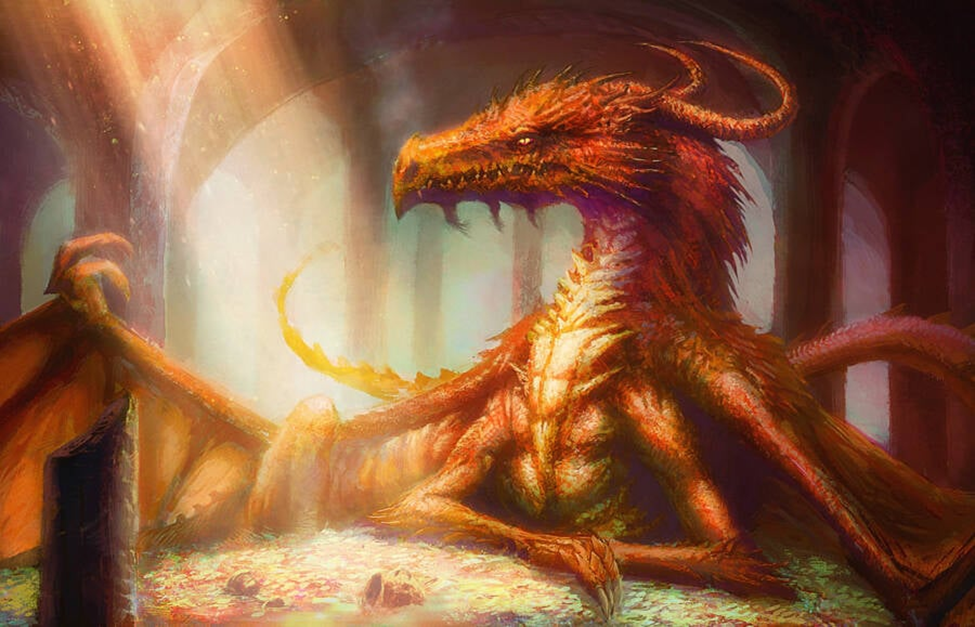
Let me be up-front about this… I have long been enthused by the concept of Dragons, and the question of whether or not they ever existed in our world. I find the suggestion of very large creatures with wings, claws and scales, a creature capable of flying and breathing fire captivating. The only “proof” we have, is the fact that all significant cultures around the world have – or had – art depicting such creatures. That information leads us to questioning the belief.
History has told us that in ancient times the Vikings reported experiencing “sea monsters”, but with little detail other than “a vicious, murderous creature of the seas”, and the Scots have the Loch Ness monster, affectionately known as Nessie, is a mythical creature said to inhabit Loch Ness in Scotland, often described as large and long-necked. Despite numerous reported sightings, there is no conclusive evidence supporting its existence, leading many to consider it a myth. Could Nessie possibly be a sea-going Dragon? One would think, that today’s ocean technology could detect and identify such creatures… but they have not done so.
Dragons have been arbitrarily classified into one of two geographic categories, European Dragons and Asian Dragons… perhaps because in early times, Europe and Asia were considered the only major land masses. The idea of dragons within those two dragon classes, is quite similar but also notably different!
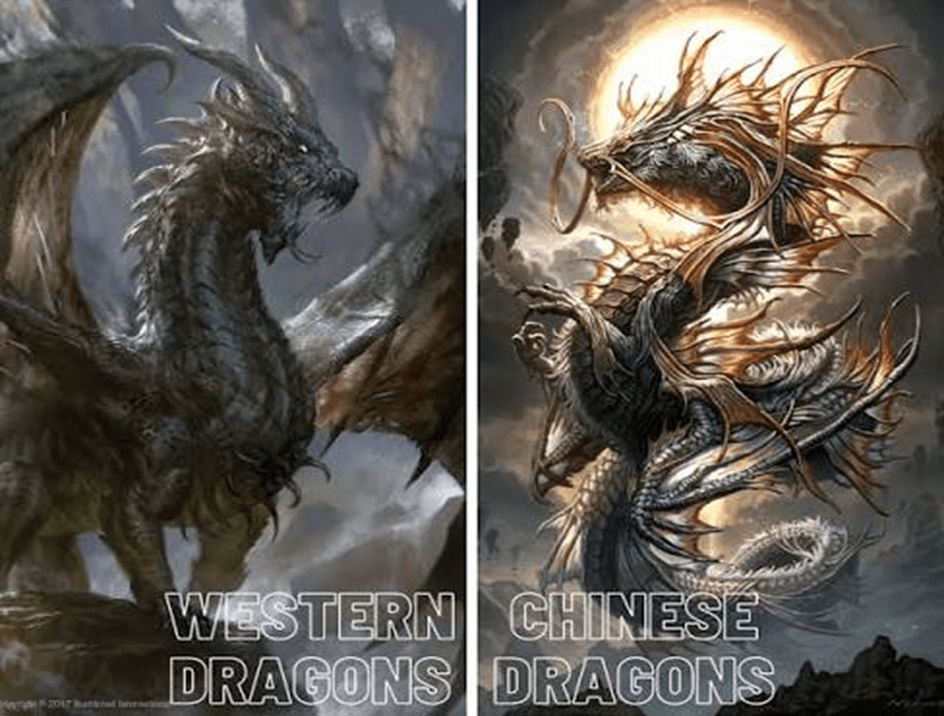
The “Western” (European) Dragon was described as vicious and fearsome, and to be avoided at all costs, while the Chinese Dragon was described as more benevolent and representing nature.
Context: European dragons are often portrayed as fearsome, fire-breathing monsters guarding treasures and terrorizing villages, embodying chaos and destruction. In contrast, Asian dragons are revered as wise, benevolent beings associated with water, prosperity, and good fortune, symbolizing harmony rather than fear, reflecting differing cultural attitudes toward nature and power. Tremendous difference!
Both Europe and Asia had very strict rulers, so the difference in the dragon’s assigned personas seems to be one of rulers’ attitudes. I therefore assume the Asian people were less resistant to change, than were the Europeans.
Scientists have generally agreed the answer to the question “Did dragons exist?” is a resounding no, yet there is still something peculiar about how widespread the mythological creatures have been in human culture. Today, we can thank the likes of J. R. R. Tolkien and Dungeons & Dragons for the mass appeal of these fire-breathing, flying beasts, but historically speaking, did dragons ever exist? And if not, where did the idea originate?
Researchers have curiously proposed that belief in the existence of dragons evolved independently in Europe and Asia. However, even that theory does little to actually explain how this belief came about in the first place.
The most sensible way to explain the beasts would be to look to some actual creatures that could have inspired these myths. However, other scholars have suggested that there could be an even deeper explanation as to why so many different human cultures came to believe in dragons — one that might even be ingrained into the human subconscious.
To understand how dragons have become so pervasive, we should first look at some specific examples of cultures that believed in dragons throughout history. In China and the British Isles, for instance, two distinct versions of the mythological beasts emerged.
European dragons have traditionally been portrayed as predatory creatures. In classic literature, they hoard gold and capture princesses. They burn down villages and are slain by gallant knights. These sorts of beasts are still featured prominently in popular media today, from tabletop games to video games, novels, and films. Generally, they are much heftier than their Eastern counterparts, mainly depicted as giant, winged lizards that can breathe fire.
To understand how dragons have become so pervasive, we should first look at some specific examples of cultures that believed in dragons throughout history. In China and the British Isles, for instance, two distinct versions of the mythological beasts emerged.
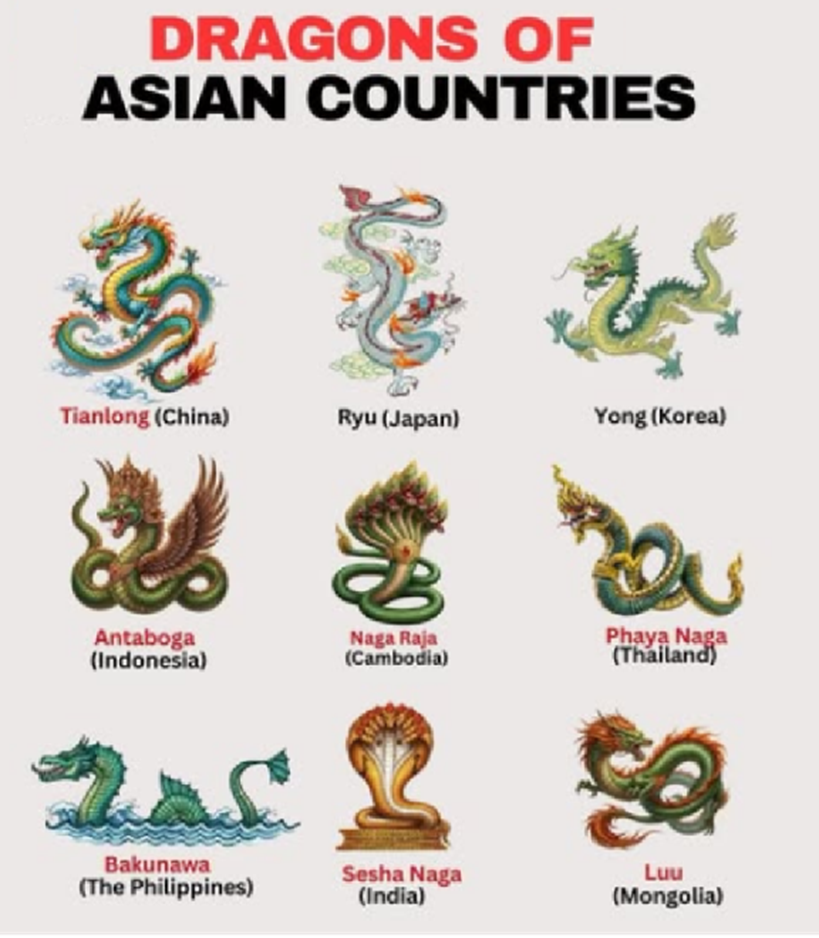
The dragons that appeared in the medieval folklore of the British Isles are greedy and vile. They live in caves and feast on livestock, humans, and even goblins or fairies in some myths.
The Origin of Mythical Dragons
According to medieval legend, the town of Klagenfurt in Austria was founded on a marsh that was home to a Lindwurm, or wingless dragon. Those wanting to settle in the area had to first deal with the dragon before founding Klagenfurt. As is traditional with dragons, this one gobbled up anyone who tried to cross the marsh. Fortunately, a local duke funded the building of a stone tower in the swamp. (Local legend is not specific on how the builders avoided becoming dragon chow.)
Once the building was complete, the locals fished for the dragon from the safety of the tower, using a chain for line, a bull for bait and presumably a hefty hook. Eventually, they captured the beast.
At this point in history, the dragon seems to have been little more than an enormous and fearsome water snake. But in the way of creatures both biological and mythical, it evolved. By 1287, the city’s coat of arms shows the monster as having the head of a wolf, the body of a bird and the tail of a snake. Within a few centuries, it had grown legs, evolving into something we would recognize today as a typical flying, fire-breathing dragon.
Are Dragons Real?
Adrienne Mayor, a classical folklorist and historian of ancient science at Stanford University, has argued that ancient people conceived dragons and other mythical creatures after finding fossils of even more ancient creatures.
In her book The First Fossil Hunters, Mayor shows how fossils influenced Greek and Roman stories about bygone creatures — and not just dragons. She also says that the idea of human giants and larger-than-life heroes could have come from the discovery of the outsized bones of prehistoric mammals.
If Mayor is right, dragons are not entirely fictional beings. The people who imagined them and told stories about them were imagining and telling stories about animals that once walked the Earth. They got the details wrong — just as we often do when studying ancient fossils. (Remember when we thought Stegosaurus had a second brain in its butt?)
But even when they were far from accurate, the stories our ancestors told about dragons and their mythical kin have enriched culture and no doubt inspired a lot of science as well.
It’s clear that, aside from sharing a name and a few lizard-like qualities, the European and Asian dragons couldn’t be more different. This distinction is what has led scholars to conclude that belief in the existence of dragons developed independently in these regions. Yet, the similarities can’t be ignored. Why would so many people from such a wide variety of backgrounds have stories about giant, flying, lizard-like creatures? Surely, there must be some sort of scientific explanation for this. Indeed, there are quite a few.
The most obvious theory about why people believed in dragons is also the most straightforward: dinosaurs. As BBC’s Science Focus magazine reports, people across Europe and Asia have historically mistaken dinosaur fossils for dragons. Even without this context, pictures alone could tell us this — the massive, scaled beasts look a whole lot like many dinosaurs, albeit with some fantastical embellishment.
And though we most often associate dragons, in the European context at least, with the Middle Ages, this was hardly the first time a dragon-like creature was mentioned in literature. The Bible, for instance, tells of a massive sea creature known as the Leviathan. Greek mythology featured a number of odd beasts, such as the Hydra. Even legends like that of the Kraken, though it does not look like a dragon, show how humans have always created massive, horrifying creatures that resemble the more mundane animals on Earth.
Smithsonian Magazine offers up a few other ancient creatures that could fit the bill, including Nile crocodiles, goannas, and whales. Any giant animal could have been used as evidence for the existence of dragons, particularly during a time when belief in magic was much more common than it is today.
The magazine also cites anthropologist David E. Jones’ An Instinct for Dragons, in which he hypothesized that humans have a built-in fear of predators that includes snakes, birds of prey, and elephants. Therefore, it is entirely possible that, by some subconscious effort, humans combined these animals into one mythical apex predator.
This could also explain why many stories involve courageous humans — most often knights — conquering the beasts, as if to allegorically show how humanity can overcome its fear.
Why, then, would the mythological creatures serve a different role in the legends of Asian countries? A report from TIME in early 2024 explains this in part, though historians and archaeologists still debate where the Chinese dragon first originated.
One of the earliest examples of Chinese dragons can be traced back more than 5,000 years. In 1987, archaeologists discovered a six-and-a-half-foot-long dragon mosaic made of clam shells in a tomb in Puyang, China. The depiction dates back to the Neolithic Yangshao culture, which existed from around 5000 B.C.E to 3000 B.C.E.
There are four credible theories that could explain where the Chinese dragon, or loong, originated. The first theory posits that it came about due to the worship of a snake-like deity. The second suggests it could have had something to do with the Chinese alligator. The third implies some connection to rain, and the last said it came about as a byproduct of nature worship. The Chinese dragon has also long been associated with power, with many legends suggesting loong fathered China’s various emperors.
So… DID THEY or DID THEY NOT ever exist in our world? It isn’t impossible that they did exist in one form or another, it is also probable that skeletons of dinosaurs have mistakenly been described as dragons.
Those who wish dragons had been real in the extremely long past (like myself) are entitled to that belief. Those who believe that all reports and art depicting dragons is nothing more than imaginary mythology, are equally free to that belief.



Leave a Reply