• Preternatural is defined by the Merriam-Webster Dictionary of the English Language as:
    1: existing outside of nature
    2: exceeding what is natural or regular : extraordinary
    3: inexplicable by ordinary means

    Now we should all be on the same or very similar – page about the ‘what’ of the word preternatural.. If I were to define preternatural, I would also include precognitive dreams, similar to, but not exactly that ewhich we call ‘Deja vu’. Precognitive dreams are dreams that appear to predict future events, but there is currently no scientific evidence that they can genuinely foresee the future. Many people report having experienced such dreams, often identifying them only after the related event occurs.
    My position on that, is of course it would be “after the event occurs”, as it cannot be validated until then!

    I have existed on planet Earth for eight decades, during which time I have experienced many preternatural events, beginning in my mid-teens. I recall two such events of the precognitive dream category, one of whch may have saved my life. My dream state is usually lucid, meaning I can see parts of/all my person within the dream. I normally have complete control of the dream.
    I have been riding motorcycles since my 13th year.
    OUIJA BOARD
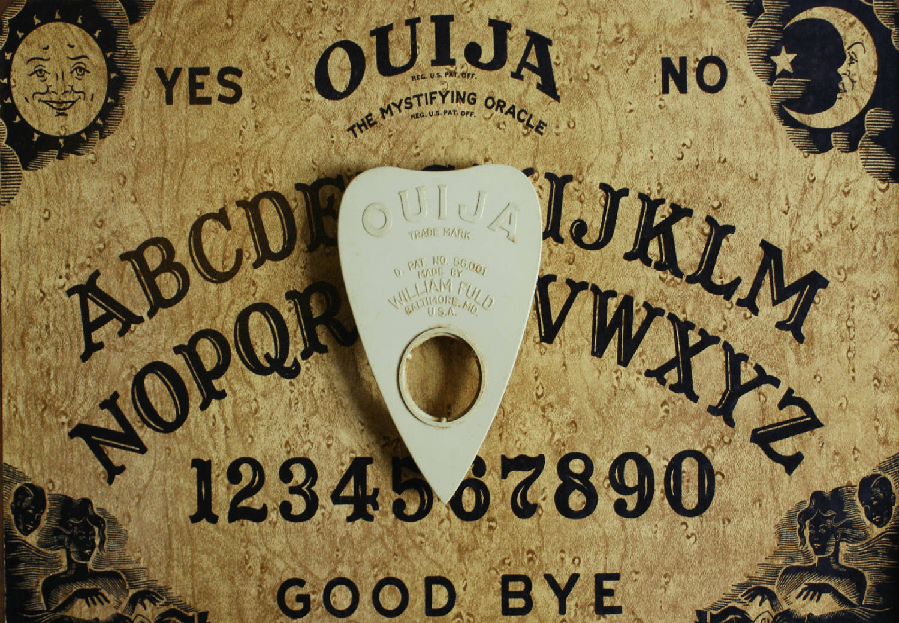
    I have had two experiences with the OUIJA Board, The first at ther age of 11, with my Grandmother. I had tried to phone my friend, Bobby that morning, but there was no answer. My G’ma got her OUIJA Board out, and we sat down to ‘play’. BE ADVISED – THE OUIJA BOARD IS MUCH MORE THAN A TOY!!
    We each placed our hands on the planchette, and asked , “Where is Bobby?” The planchette began moving… M…O…V…I…E, M…O…V…I…E. Later that day I called Bobby’s phone again… he answered, and I asked where he had benn today, and he said he had gone to the movies with his mother. In my 11 year old mind, that made the OUIJA a fun toy!
    My next OUIJA experience was after about a year in the US Navy. I was then 18, and had multiple shipmates as friends. One day a friend produced a OUIJA board, which was a big surprise to me. I didn’t question him about where, when or how he came by the board, and we sat down to use the OUIJA. Hands on the planchette, it began moving around the board. It went “VI HOT‘, repeating that three times. We paused, looking at each other, and it meant nothing to either of us. That was when one of our eight observors spoke up saying, “I know what it means. My sister, Violet and I, were raised on a farm. By the barn there was a 55 gallon drum of fuel on a stand, for our farming equiment. The drum had a very minor pinhole leak at the very top. The family always called sis Vi, and she was a 7 year old adventurer. One day she found some matches, and nobody kne she was playing with them near the drum of fuel. Somehow, she ignited the drum, and died immeidately. The best guess was that she was trying to ‘dry out’ the leak from the heat.”
    We immediately stopped ‘playing’, and I never saw that board again!

    PRECOGNITION
    The first Pre-Cog dream was about 6 months bedore the event, and it showed me riding a motorcycle West on 40th Street South in St. Petersburg, FL. (we were Living on 40th SS, at the time, so that – in and of itself – was not unusual). About ¼ mile from my home the was a 3-4 foot elevation in the street due to railroad tracks crossing at that point. As I was approaching the giant speed bump, I attempted to reduce my speed by closing the throttle, which I failed to achieve. I then pulled my clutch, and kicked my transmissioon down one gear, which took effect just as I reached the base of the street hump. My bike and I became airborne. and after peaking at about 8 feet, I made a safe no-brakes landing, knowing that landing with brakes applied would be quite dangerous. And that happened exactly as my precog dream had said it would be.
    The second p-c experience was much simpler. I was attending St. Petersburg Jr. High, and two friends approacched me during lunch break, as I was on the tarmac shooting some hoops.As they got closer, they asked me if I wanted to skip school the next day to celebrate the annual Gasparilla Day in Tampa, FL..
    José Gaspar, also known by his nickname Gasparilla, is a mythical Spanish pirate who supposedly terrorized the Gulf of Mexico from his base in southwest Florida during Florida’s second Spanish period. Though details about his early life, motivations, and piratical exploits differ in various tellings, they agree that the ‘Last of the Buccaneers” was a remarkably active figure who amassed a huge fortune by capturing many vessels and ransoming many hostages during his long career, and that he died by leaping from his ship rather than face capture by the United States Navy, leaving behind his still-hidden treasure.

    And sure enough, as I was forewarned by the p-c dream, it happened just as it was predicted. And, yes, I did attend the 1958 celebration of José Gaspar and his pirate crew!

    I have also percieved two OBE’s (Out of Body Experience). However, both of these occured during sleep, and may have been nothing more than lucid dreams, Which is why I present it as “perceived. To me, it was real, but I will not go into further detail. These were in my early-mid 30’s, while stationed at Keesler Air Force Base, Bilioxi, Missippi.

    Then there was the Phantom House
    I enlisted in the US Navy when I turned 17 years of age, and went to Basic Training at Great Lakes Naval Training Center in Ilinois. Upon completion of that training, I returned home on leave. I contacted my best firiend, Pete, upon my return and we decided to get together and celebrate my achievement..
    In the mid-1950’s there was a place in St .Petersburg, FL called “Garth Hollow” by we teens. It was a mile or so North of the original Sunshine Skyway Bridge. Garth Hollow itself was a strange place, sitting directly along the Tampa Bay channel.

    There was a one lane narrow dirt road, lined with scrub palmettos and assorted wild bushes and trees. The main attraction for us was an old Colonial-style, south-facing two story home… veranda and Colonial supports on the porch. In front of the home was a small kidney shaped pool, about 2’X3’, and the water in it was so black it was like looking into a black mirror, and a small rotted wooden jetty. Also on the west side of the property was an old carriage house, and a dirt berm containing and small concrete closet-like structure with no door and one window with three rebar’s in it.

    The “story” that went with Garth Hollow is that it was last owned by an old couple who had a Great Dane dog. All three were supposedly buried on the property, and at some point in time their graves were robbed (I assume it was just the people’s graves). It was also told that they people were NAZI sympathizers during WWII, and the jetty was support for German U-boats.

    I never went into the house, but some kids did. I did however enter the carriage house to see what it looked like. Upon turning to leave, I noticed a perfectly painted swastika above and inside the entrance. This reinforced the NAZI story in my teenage mind.

    One day one of the kids decided to hop up the stairs to the second floor. About half-way up he went thru a stair and broke his leg. One of the older boys dad, owned a Sinclair service station in St.Pete (49th St & 15th Ave South), and it was equipped with an Army surplus A-Frame wrecker. He borrowed it, and about 50’ of heavy duty chain one day, drove it to Garth Hollow, and destroyed the old house. Flattened like a pancake.

    2 years later, I returned to St. Pete on leave, having just completed Navy Boot Camp at USNTC Great Lakes, IL. I contacted my best friends, Pete M., and we decided to celebrate my graduation. Pete had a car, so we stopped by a Lil General and I picked up two 40oz Country Club Malt, one for each of us. It was dark outside, and even darker in Garth Hollow that night, We chose Garth Hollow for two reasons, it was secluded and neither of us were of legal age to drink.
    We pulled into the hollow and parked in front of where the house once stood. I asked Pete if he had a ‘church key’, and he said, “In the glove box.” I found it and was about to open our beer when…… I looked up and saw the ‘Phantom House’ standing. It appeared to be transparent and in 3D, like what we know as a hologram today, but this was two years before the hologram was even started to be developed. I just froze in my seat, and said to Pete, “Do you see what I see?” He looked back through the windshield, said not a word, started the car again, and we were OUTTA THERE!

    And THAT was my experience with the Phantom House of Garth Hollow!
    YOUR THOUGHTS?


  • According to the Merriam-Webster Dictionary of the English Language, “Truth” is defined thusly:
    truth

    noun
    ˈtrüth 
    pluraltruths ˈtrüt͟hz  ˈtrüths 
    Synonyms of truth

    1
    a(1): 
    the body of real things, events, and facts : actuality

     (2): the state of being the case : fact

     (3) often Truth : a transcendent fundamental or spiritual reality

    b(1)

    a judgment, proposition, or idea that is true or accepted as true

     (2)

    truism

    c: the body of true statements and propositions

    2a

    the property (as of a statement) of being in accord with fact or reality

    b

    chiefly British : true sense 2

    Her propeller shaft was a trifle out of truth

    c

    fidelity to an original or to a standard

    3

    a

    sincerity in action, character, and utterance

     see also live one’s truth

    b

    archaic : fidelityconstancy

    IS THERE A UNIVERSAL TRUTH?
    I believe that there is such a thing, but there are only a miniscule number of those who know the universal truth

    c: fidelity to an original or to a standard

    3

    a: sincerity in action, character, and utterance

    b

    archaic : fidelity, constancy


    IS THERE A UNIVERSAL TRUTH?
    I believe there is a strong possibility of a Universal Truth. However, I also believe that those who may “know” such a truth are a miniscule number, and those who are cognizant that they have such knowledge is even fewer. Possessing the Truth of all Truths would be a Unicorn rarity among humankind, because of its importance… perhaps Mahatma Gandhi had such knowledge, but that we shall never know. Known Universal Truths of today, are generally science-based. Accepted ‘’universal truths” include such as:
    The Sun rises in the East and sets in the West.
    Water is damp to wet.
    The Earth rotates around the Sun (once every 365.25 days while also rotating on its axis every 24 hours. This dual motion causes the cycle of day and night as well as the changing seasons).
    Snow is cold to the touch

    ARE THERE DIFFERENT TYPES OF “TRUTHS”?
    This is also a truth, or at least my personal truth. A “personal truth” is one to which the believer ascribes. I use “ascribes” vs subscribes because the belief in an omniscient “Supreme Being” (and/or a multitude of specialized beings, as do the Catholic and Hindu religions) is worldwide. Humans seem to need a superior entity to explain the unexplainable, and to blame for their personal shortcomings. As often as not (or perhaps more so), any credit for grandiose personal achievements, is celebrated in the realm of that human’s individual brilliance.

    Personal Truths
    May or may not be shared by a large number of others, it is usually validated within the individual’s circle of close friends. This is due to the human instinctual search for likeminded associates (aka: “birds of a feather”). In general, we humans like to avoid conflict and consternation whenever it is possible, while the morality-lacking other creatures on Earth, simply kill – or are killed – by the others with whom they may disagree.

    Group Truth
    The arena of scientists, religious groups, gang members, mobs and fraternal/sororal organizations.
    Scientists assume the responsibility for scientific knowledge and science-related facts in their particular field of expertise. They do that via majority vote, as they did when the planet Pluto, discovered in 1930, was reduced – after 76 years – to the status of a dwarf planet in 2006 by the International Astronomical Union, to that of a Dwarf Planet. Oddly, this is the result of whimsically redefining the requirements for planet status.
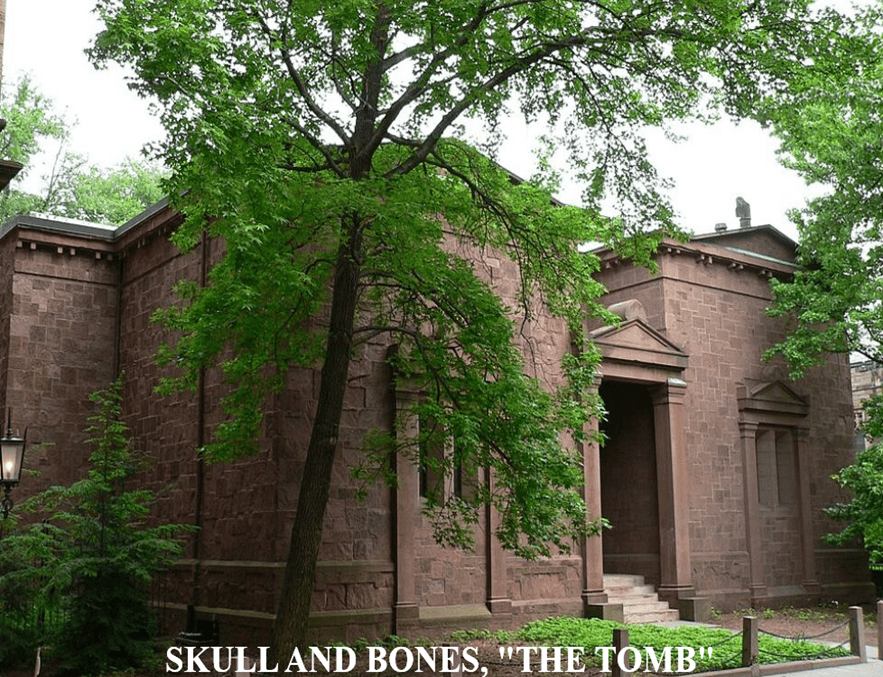
    Fraternal and Sororal organizations are well known for keeping ‘secrets’ of each organization from all who are not members. The Skull and Bones (also known as The Order, Order 322 or The Brotherhood of Death) is an American undergraduate senior society at Yale University in New Haven, Connecticut. Many of America’s politicians, moneyed class and celebrities have been/are members of that organization. Fraternal and sororal organizations, often collectively referred to as Greek letter organizations (GLOs) due to their frequent use of Greek alphabet letters in their names, represent a significant aspect of social and cultural life, particularly in North America and parts of Europe. These groups, characterized by their shared rituals, values, and philanthropic activities, offer members a sense of belonging, networking opportunities, and avenues for personal growth.
    Skull and Bones stands as one of America’s most exclusive undergraduate secret societies, limiting membership to fifteen Yale seniors each year who are “tapped” for their achievements and potential. The society conducts activities in a windowless building known as “The Tomb,” where members participate in secretive rituals that remain largely unknown to outsiders. What sets Skull and Bones apart is the extraordinary success of its alumni, including multiple U.S. presidents, Supreme Court justices, and business leaders who have shaped American politics and culture. The organization’s secretive nature, combined with its members’ prominent positions, has fueled numerous conspiracy theories about its influence on American policy and global affairs.

    Religious Groups have strong belief systems, including “all that is, is the result of the Supreme Being creating it”. Balancing of that belief, against the “Big Bang Theory” (belief that “it just happened” as an act of nature). Generally, such debates usually end in a zero win tie, as neither one is objectively provable.
    For “Christians”, the first major printed Bible is known as the Gutenberg Bible, produced in the 1450s (1,450 years after the passing of its hero) by Johannes Gutenberg. It is an edition of the Latin Vulgate and marked the beginning of the age of printed books in the West. The first complete English translation of the Christian Bible was produced by John Wycliffe and his followers in the 1380s. However, parts of the Bible had been translated into Old English centuries earlier. The believers are also asked to believe that there were never any mistakes made by fallible human beings, due to Supreme Intervention (or words to that effect), upon those efforts. I find that, to be a stretch too far for the objective mind to accept, as it teeters upon the ledge of fantasy. However, given that the estimated number of Christians worldwide is approximately 2.3 billion, making up about 28.8% of the global population, such belief is not odd or unusual. It is valid for more than one person in four! Keep in mind though, that “beliefs” need not be scientifically proven to be earnestly accepted as truth. Supposedly, the Son of God once said, “I am the way and the truth and the life” is a statement made by Jesus in the Gospel of John (14:6), emphasizing that He is the only path to God and eternal life.

    Political Truths are extremely difficult to identify, particularly during campaign season. The “truths” espoused by politicians change somewhat depending upon the known tastes of the politician’s audience. Most politicians use weasel words when addressing a physical or broadcast audience. Weasel words are used to create vague or ambiguous statements that can mislead or avoid making definitive claims. They allow speakers or writers to hedge their statements, providing a way to deny specific meanings if challenged. There is very little identifiable truth in political statements.

    Mob Truth is designed and financed at a publicly unknown level, because it is generally believed to be a tool of social/political rebellion and is chaos-based. Acts of vandalism, arson and physical violence are to be expected. Such “truths” are financed by the moneyed elite class, for a wide variety of reasons, and executed by believers’- both personal and professional – thereof. The leadership of a mob, generally has a cadre of extremist minions throughout the mob to keep the group motivated, and on edge.

    SUMMARY
    That which is truth to us, is a personal belief, which may not pass scientific investigation… nonetheless, it may remain our belief forever. We humans tend to be extremely reluctant to accept challenges of that which we believe.

    YOUR THOUGHTS?

  • WHAT EXACTILY ARE PERSONALITY TRAITS?
    The Big Five theory suggests that personality can be described through five broad dimensions:

    Openness to Experience: Involves curiosity, creativity, and openness to new ideas. High scorers are imaginative and adventurous; low scorers prefer routine and practicality.

    Conscientiousness: Reflects self-discipline, organization, and reliability. High scorers are responsible and goal-oriented; low scorers may be more spontaneous and less organized.

    Extraversion: Describes sociability, assertiveness, and energy. High scorers are outgoing and thrive on social interaction; low scorers tend to be more reserved and quiet.

    Agreeableness: Involves kindness, empathy, and cooperation. High scorers are compassionate and value harmony; low scorers may be more competitive or blunt.

    Neuroticism: Measures emotional stability and sensitivity to stress. High scorers are more anxious and prone to mood swings; low scorers tend to be calm and resilient.

    Each trait exists on a continuum, and most people fall somewhere between the high and low ends for each dimension.
    We are all different. While some people are naturally outgoing and talkative, others are quiet and reserved. Some are adventurous and love trying new things, while others prefer routine and predictability.

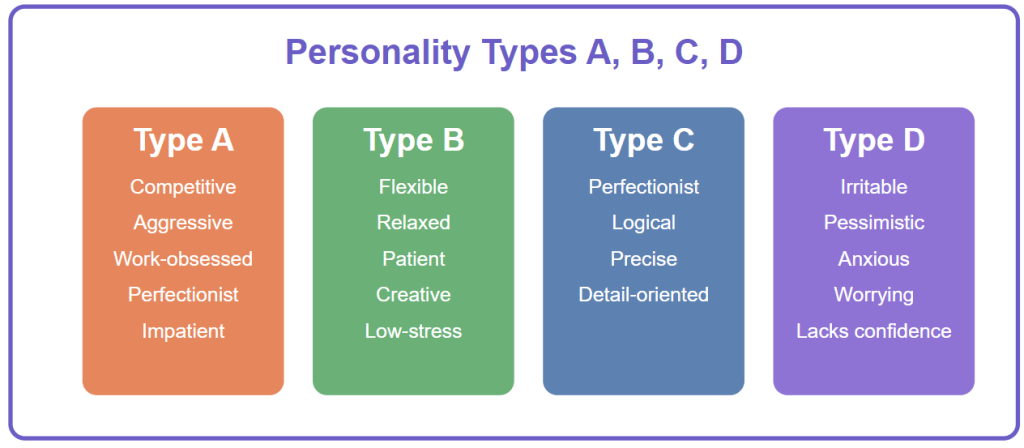
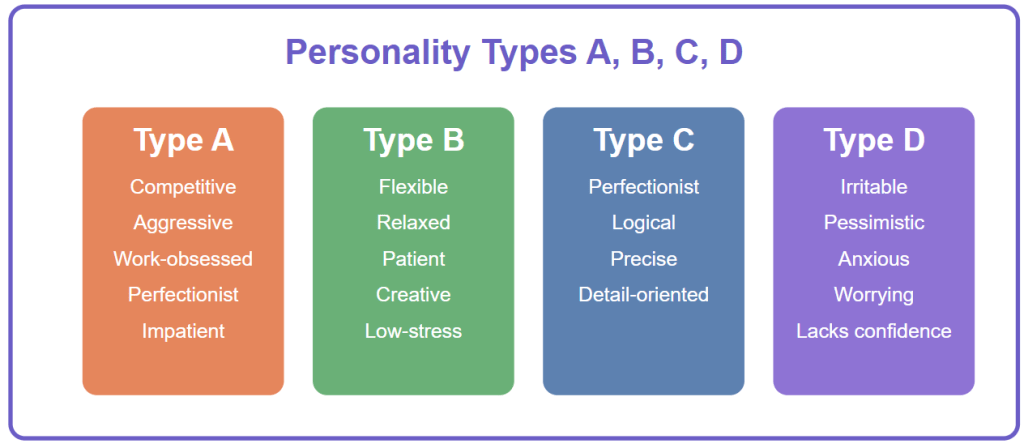
    One theory suggests that personality can be categorized into A, B, C, and D.

    Type A Competitive, aggressive, work-obsessed, hostile, impatient, perfectionist, stressed. This is where most people in superviory or control are inclined toward. CEO’s, COOs’, CFO’s, and HR, shift supervisors, career Military and Law Enforcement. Creators of things and services – Abraham Lincoln, Thomas Edison and Elon Musk and doctors are prime examples of Alpha Personalities. Politicians in general, tend toward the Type A personality. The Type A personality is driven toward control and leadership positions, and during that search they may be less-than-trustworthy to others, because they will do anything to acheive their goals!

    Type B Flexible, relaxed, patient, creative, even-tempered, low-stress, prone to procrastination. Counselors/Psychologists, Public Relations, Clergy, Lawyers and labor superviors tend to be Type B personalities.

    Type C:  Perfectionist, logical, more precise, detail-oriented. This is the environment of Mechanics, Physicists, Surgeons, Architects, and Engineers.

    Type D:  Irritable, pessimistic, anxious, hopeless, worrying, sad, gloomy, lacks self-confidence. This category type tends to include those who have never developed social and/or marketable work skills. The most noteworthy charateristic of the Type D, is that they are irritants to Type A-C, and they tend to distract others with their misery, Most likely undereducated, frequently unemployed, and recipients of Welfare support.

    I seriously doubt that anyone is a full-time fixed type. We tend to shift types when there is a change in our environment. A lothario is essentially an actor, and most likely to have access to both Type A and Type B personalities, and will shift back and forth as the perceived need dictates. We all tend to observe our working/social environments, and may reactively make small adjustments through all of the four personality types as any significant changes are percieved.

    PERSONALITY DEVELOPMENT – WHERE DOES PERSONALITY COME FROM?
    Some of the biggest questions in personality psychology have something to do with how individuals develop personalities and how much of someone’s personality changes throughout their lives.

    Theorists, such as Sigmund Freud, beleived personality to be static, already developed at a young age. However, due to modern personality research, we now know that personality can change over time. So, while the broad traits may remain constant, a person’s overall personality can change, particularly as they age.

    According to research, people tend to show signs of maturity in personality test scores, especially emotional stability, as they age. Personality change can also occur due to exposure to different environmental factors or circumstances, such as divorce or becoming a parent. You can also try to deliberately alter some aspects of your personality characteristics by trying to behave differently.

    PERSONALITY DISORDERS
    Personality differences determine much more than self-image, including differences in health and well-being, personal success, and the quality of relationships. Even the risk of mortality is associated to some extent with the differences in personality traits.

    Personality also interesects with mental health. A healthy personality allows one to manage the everyday stresses of life and develop and sustain satisfying relationships. That doesn’t mean we will not have a bad day or two. However, when enduring patterns of behavior, thinking, and emotional response are inflexible and rigid, causing significant distress or difficulty in functioning, a person is likely to be diagnosed with a personality disorder.

    To be diagnosed with a personality disorder, one’s patterns of thought and behavior have to be different from what is believed to be expected in their culture.

    The onset of personality disorders is usually in early teens or late adulthood. The cause is unknown, although genes and early childhood experiences like trauma and abuse are likely to play a role. Examples of personality disorders include borderline personality disorder, antisocial personality disorder, obsessive-compulsive personality disorder, narcissistic personality disorder, and paranoid personality disorder, among others. Without treatment, these disorders can be long-lasting and destructive to a person’s everyday life. Thankfully, there are ways to treat and manage personality disorders, including talk therapy and some medications to relieve specific symptoms like mood swings or anxiety. For proper diagnosis and treatment, seek the services of a mental health professional.

    YOUR THOUGHTS?

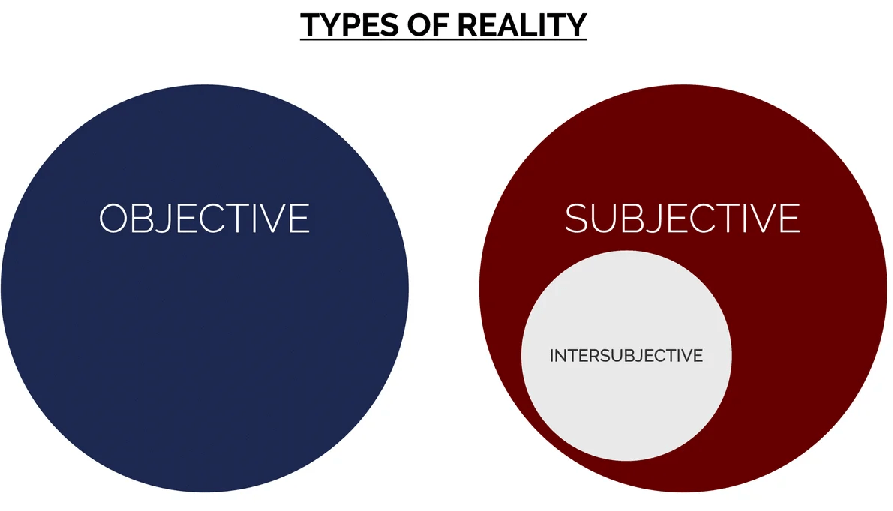
  • There are three main types of reality: objective reality, which is measurable and exists independently of human perception; subjective reality, which is shaped by individual experiences and beliefs; and intersubjective reality, which exists through collective agreement among people. Understanding these distinctions and using them properly is advantageous and can help clarify how we perceive and interact with the world.
    Confusing the three types
    causes misunderstanding, emotional reactions and irrational thinking.

    I do not believe that anyone is totally objective all the time. We are human beings, and designed by our Creator to be imperfect!

    Our “reality” can shift moment-to-moment, day-by-day… it is not a fixed condition, and as such is subject to outside influences. Elemental and moderate social changes are to be expected. Those with a predominately objective evaluation of life, will recognize those changes, and modify, adapt and overcome – with varying degrees of success – those viscititudes.
    Th e “homeless” sub-population are an excellent example. Those who have recently entered the community of the homeless, may modify and adjust by moving in with relatives. In their objective reality, they may believe the relatives glad to help them in their time of need. Food and shelter are the immediate, primary needs of all humans. They who are accepted by relatives or others, stand the best chance of restoring themselves to at least a modicum of thier reality.
    Those who cannot, or choose not to involve relatives, will find their new environmental situation distressing, untenable… and the longer they remain in that sub-population, the greater the chance of mental illness! Approximately 67% of people experiencing homelessness have acquired, or brought with them, mental health disorders – perhaps due to their.loss of objective reality in their unfamiliar social environment. Schizophrenia finds a quick and easy home within the homeless encampments.

    In a subjective reality, shaped by individual experiences and beliefs, life become more or less complex. The transgender community is an excellent example of a combination of subjective and intersubjective realities. Their subjective reality permits them to question thier birth determined sex… but feelings are emotional, and thereby less than reliable. Emotions are reactive-based, and can shift quickly depending on the stability of the situational environment. Nonetheless, the transgender individual has little objective reality, and is irrational regarding his/her/their actual sense of physical sex. This is accepted behavior throughout the transexual community. Where they make their mistake, is expecting the objective world to support their fantasy. The only people who may understandably question their sex, would be those who are born hermaphrodites, an organism that possesses both male and female reproductive organs, allowing it to produce both male and female gametes. This is uncommon in human beings,. -1.7% is a commonly cited estimate for intersex traits overall (about 1 in 60), but this includes a broad
    range of conditions and may reflect traits that might not be noticed at birth in many people.), but not in the rest of the animal world and plants. Animal species in which individuals are either male or female are gonochoric, which is the opposite of hermaphroditic. Plant species in which individuals are either male or female are dioecious. The individuals of many taxonomic groups of animals, primarily invertebrates, are hermaphrodites, capable of producing viable gametes of both sexes. Atypical genitalia is not a disease; it’s a difference of sex development. Usually, atypical genitalia can be seen at or shortly after birth. The condition can be very distressing for families. Your medical team looks for the cause of atypical genitalia and provides information and counseling that can help guide decisions about your baby’s sex and any needed treatment. Hopfully, the deisred sex of the infant will be decided by the parental unit(s) in conference with the doctor(s) early in infancy, in order to minimize social problems for the chilld as it develops. For exampole, in kindergarten little “Johnny” suddenly appears one day as little “Joanie”. This is an instance which could follow the child throughout his/her life without corrective action.

    In the intersubjective world, which exists through collective agreement among people, is undoubtly the basis of social norms. The world of the “normies” – who tend to agree on scientific facts – such as:
    the Sun rises in the east and sets in the west, rain is wet, grass is green, unprovoked taking of a human life is forbidden, etc. The most powerful areas of disagreement among the normals are religion and politics, both of which are belief-based… which is where subjective reality enters the ‘stage of life’.

    We should all expect to primarily engage in one of the three types of reality, but allow ourselves to access and be aware of the presence of the other two types. When understood – and kept in balanceone’s life – overall – should be fairly simple and pleasant. The deciding factor will be your personality type.
    Type A personalities are ambitious, competitive, and often impatient (in a group of alphas there will usually be at least an almost palpable tension, because each the individuals believe they should be the leader)., while Type B personalities are more easygoing and relaxed. Type C personalities tend to be detail-oriented and introverted, and Type D personalities are characterized by negative emotions and social inhibition.

    BUTthat’s a discussion for another time! À bientôt mes amies!!

  • A barbarian is, etymologically, a foreigner, specifically someone whose language and customs differ from those of the speaker. In ancient Greece, the term designated non-Greeks, while in the Roman world it referred more generally to peoples living outside the cultural and political sphere of the empire

    For the last four decades the “progressive left” of our Democrat/Democrat Socialists of America elected to serve as POTUS, have left our backdoor open to the barbarians of the “third world”. They are the disrespectful, despicable dregs of humanity, who do not come here to assimilate and become Americans. The only skills they bring into our Republic, are antithetical to the established American culture! They are, for the most part, unvetted, accomplished criminals… thieves, fraudsters, rapists and murderers!

    The federal government sends money to states to subsidize the cost of care for very low income children, and some states put additional funds into that system. In Minnesota, it’s known as the Child Care Assistance Program, or CCAP. Centers that accept children on subsidies will bill the state for the cost of caring for those kids. In 2019, a Minnesota state investigation found that there was probably several million dollars in child care fraud taking place within that system, where centers were billing for children they were not providing services for. Investigators believed the level of child care fraud in the state was more than the $5 million to $6 million prosecutors had been able to prove until that point.

    A 2025 report by the federal Department of Health and Human Services Office of the Inspector General found that issues with overpayments continue in the state. The OIG sampled 1,155 child care centers and found that 11 percent of the payments made to those centers in 2023 had errors. (“Errors”, as used here, is a broad weasel-word to save embarrassment of the DHS) But that doesn’t necessarily mean there was fraud. Improper payments is an umbrella term that could include fraud. For example, “an improper payment is a child was present for 40 hours and somehow the state paid only for 30 hours. Fraud is when you’re charging for kids that were never enrolled,” explained Danielle Ewen, a national child care expert.

    The “progressive” left (read: Socialist/Communist Democrats) has infiltrated all levels of our government, from the Department of Education to our Congress, and THAT is why we are where we are today. It took them over 100 years following the formation of the League of Nations and the ACLU (founded by Roger Nash Baldwin, a self-avowed Communist – “I am for socialism, disarmament, and, ultimately, for abolishing the state itself… I seek the social ownership of property, the abolition of the propertied class, and the sole control of those who produce wealth. Communism is the goal.”) to reach the point where they became comfortable enough to make their presence apparent.

    We have permitted serious dilution of the name American, in that all students educated after the mid-1980’s, were indoctrinated to espouse “Socialism GOOD, Capitalism BAD!


  • “Deconstruction” is a euphemism of our Republic’s Socialist Left for destruction. This is the goal of The Democratic Socialists of America (DSA) founded in 1982, “which platform advocates for a society where all individuals can live dignified lives, emphasizing democratic control over the economy, workers’ rights, and environmental justice. They seek to address inequalities created by capitalism and promote policies that ensure equal access to education, healthcare, and a sustainable environment.” On the surface, their desire sounds fairly reasonable, but closer perusal reveals its true intent. For example, whether one leads a “dignified” life is the individual’s responsibility. True dignity is somewhat of a burden according to the dictionary definition…
    MERRIAM-WEBSTER DICTIONARY
    dignity noun
    dig·​ni·​ty ˈdig-nə-tē 

    plural dignities

    Synonyms of dignity

    1: formal reserve or seriousness of manner, appearance, or language

    2: the quality or state of being worthy, honored, or esteemed

    3a: high rank, office, or position
      b: a legal title of nobility or honor

    Using that definition, the masses are, for the most part, eliminated from the concept of being “dignified”. In fact, it appears that the definition was composed for the ruling elite. By way of explanation, the term “dignified” was first used in 1584, when societies had only three classes – the Haves (moneyed class), the Merchant, and the Have Nots, of which only the Haves were “dignified”… as none who labored were “worthy” by the standards of the Haves. Although generally not defined as such today, class systems exist throughout the world. Social-Communism will not erase class systems, it will emphasize them. The political and socialupper-class will enjoy life, harvesting that which is provided by the labors of the underclass. To confirm my claim, look closely at the social structures of China, Cuba, North Korea, Russia, Venezuela and the make-believe “Palestine”.

    Both Socialism and Communism maintain control by force of arms, have “elections” in which 98%of the votes are always for the continuing that form of governance (and the other 2% mysteriously “disappear”), provide life-saving medical care for their elites, and life-ending medical care for the worker bees.

    Our Socialists will undoubtedly be joined by our Muslims, the BLM movement, the UN and our other assorted anti-American groups.
    Most of us are aware that the UN, established in 1945 as the replacement for the League of Nations, is the spearhead of the NWO/One World Government/Shadow Government/Deep State (four names, same group – pick your own favorite nom de plume). The UN is also a do nothing, money grabbing, anti-capitalist parasite. The UN Charter “mandates the UN and its member states to maintain international peace and security, uphold international law, achieve “higher standards of living” for their citizens, address “economic, social, health, and related problems”, and promote “universal respect for, and observance of, human rights and fundamental freedoms for all without distinction as to race, sex, language, or religion”. In practice, it does none of these! The UN has never convinced two nations to avoid war, has never ended a war, upheld international law, or much of anything else in its charter! What it does do is collect dues from its 192 “member states”, and charges the USA more for “dues”, than the next five highest dues paying nations combined. We the People should encourage our government to disenfranchise ourselves from the UN!

    The Democrat Socialists present the largest threat to our government and We the People – and I estimate them to compose a minimum of 80% of registered Democrats – are the radicals who desire transforming our government to socialism. We have witnessed their inaction to curtail violent protests and riots in Democrat-controlled states repeatedly! The main body of Democrats, is either unaware or simply doesn’t care that the DNC was very slowly co-opted by the Social-Communists since the mid-1950s.

    I believe that the Socialist-Communist threat was accepted with the establishment of Woodrow Wilson’s League of Nations in 1920, to which the USA did not belong, and Russia’s acceptance in the League of Nations in 1934 after initially being excluded due to its Bolshevik government. However, it was expelled in 1939 following its invasion of Finland. The “Russian Federation”, has been a United Nations member since 24 October 1945, and has spent the last 81 years bringing Communist spies and activists into the USA. If nothing else, the Communists were extremely patient in making their ideological presence known… which, after infiltrating every level of US government, began slowly in the mid-1980’s. Conservative College/University professor’s suddenly could not gain tenure, and public schools began teaching “Socialism good, Capitalism bad”, resulting in every student educated since about 1986 was indoctrinated against American values. Our Republic has been under subtle attack since that time, as part of the master plan of the Communist-backed One World Government. Unfortunately, our Constitution requires an act of violence/force before those who would overthrow our government may be charged, and tried under Title 18 US Code, below.

    18 USC Ch. 115: TREASON, SEDITION, AND SUBVERSIVE ACTIVITIES

    From Title 18—CRIMES AND CRIMINAL PROCEDUREPART I—CRIMES

    §2383. Rebellion or insurrection
    Whoever incites, sets on foot, assists, or engages in any rebellion or insurrection against the authority of the United States or the laws thereof, or gives aid or comfort thereto, shall be fined under this title or imprisoned not more than ten years, or both; and shall be incapable of holding any office under the United States.

    (June 25, 1948, ch. 645, 62 Stat. 808Pub. L. 103–322, title XXXIII, §330016(1)(L), Sept. 13, 1994, 108 Stat. 2147.)


    §2384. Seditious conspiracy
    If two or more persons in any State or Territory, or in any place subject to the jurisdiction of the United States, conspire to overthrow, put down, or to destroy by force the Government of the United States, or to levy war against them, or to oppose by force the authority thereof, or by force to prevent, hinder, or delay the execution of any law of the United States, or by force to seize, take, or possess any property of the United States contrary to the authority thereof, they shall each be fined under this title or imprisoned not more than twenty years, or both.

    (June 25, 1948, ch. 645, 62 Stat. 808July 24, 1956, ch. 678, §1, 70 Stat. 623Pub. L. 103–322, title XXXIII, §330016(1)(N), Sept. 13, 1994, 108 Stat. 2148.)


    §2385. Advocating overthrow of Government

    Whoever knowingly or willfully advocates, abets, advises, or teaches the duty, necessity, desirability, or propriety of overthrowing or destroying the government of the United States or the government of any State, Territory, District or Possession thereof, or the government of any political subdivision therein, by force or violence, or by the assassination of any officer of any such government; or

    Whoever, with intent to cause the overthrow or destruction of any such government, prints, publishes, edits, issues, circulates, sells, distributes, or publicly displays any written or printed matter advocating, advising, or teaching the duty, necessity, desirability, or propriety of overthrowing or destroying any government in the United States by force or violence, or attempts to do so; or

    Whoever organizes or helps or attempts to organize any society, group, or assembly of persons who teach, advocate, or encourage the overthrow or destruction of any such government by force or violence; or becomes or is a member of, or affiliates with, any such society, group, or assembly of persons, knowing the purposes thereof—

    Shall be fined under this title or imprisoned not more than twenty years, or both, and shall be ineligible for employment by the United States or any department or agency thereof, for the five years next following his conviction.

    If two or more persons conspire to commit any offense named in this section, each shall be fined under this title or imprisoned not more than twenty years, or both, and shall be ineligible for employment by the United States or any department or agency thereof, for the five years next following his conviction.

    As used in this section, the terms “organizes” and “organize”, with respect to any society, group, or assembly of persons, include the recruiting of new members, the forming of new units, and the regrouping or expansion of existing clubs, classes, and other units of such society, group, or assembly of persons.
    (June 25, 1948, ch. 645, 62 Stat. 808July 24, 1956, ch. 678, §2, 70 Stat. 623Pub. L. 87–486, June 19, 1962, 76 Stat. 103Pub. L. 103–322, title XXXIII, §330016(1)(N), Sept. 13, 1994, 108 Stat. 2148.)

    Zohran Kwame Mamdani, legally elected Mayor of  NYC, is running NYC as a Socialist city. Technically, Title 18 protects only the United States government, not lesser political subdivisions. Mamdani has not kept the vast majority of his campaign promises. I wonder how STUPID the majority of NYC’s residents must be to have made Mamdani Mayor?


  • Dragons Appear In The Tales Of Many Cultures… Were They Once Real?
    Various cultures throughout history believed in dragons, likely as a way to explain fossils of dinosaurs and other prehistoric creatures.

    Mythology and folklore about dragons can be found in a wide variety of cultures throughout history. While specific details may vary, legends about the beasts are among the most pervasive stories humans have ever told. They are so pervasive, in fact, that many have wondered: Were dragons real?

    Let me be up-front about this… I have long been enthused by the concept of Dragons, and the question of whether or not they ever existed in our world. I find the suggestion of very large creatures with wings, claws and scales, a creature capable of flying and breathing fire captivating. The only “proof” we have, is the fact that all significant cultures around the world have – or had – art depicting such creatures. That information leads us to questioning the belief.

    History has told us that in ancient times the Vikings reported experiencing   “sea monsters”, but with little detail other than “a vicious, murderous creature of the seas”, and the Scots have the Loch Ness monster, affectionately known as Nessie, is a mythical creature said to inhabit Loch Ness in Scotland, often described as large and long-necked. Despite numerous reported sightings, there is no conclusive evidence supporting its existence, leading many to consider it a myth. Could Nessie possibly be a sea-going Dragon? One would think, that today’s ocean technology could detect and identify such creatures… but they have not done so.

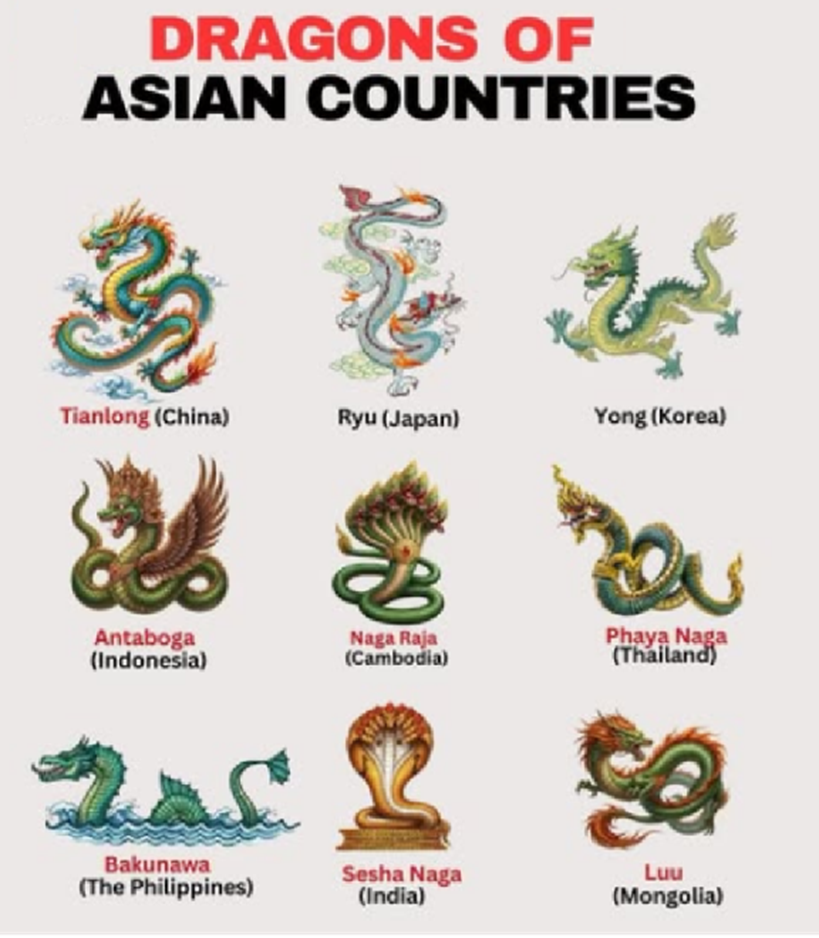
    Dragons have been arbitrarily classified into one of two geographic categories, European Dragons and Asian Dragons… perhaps because in early times, Europe and Asia were considered the only major land masses. The idea of dragons within those two dragon classes, is quite similar but also notably different!

    The “Western” (European) Dragon was described as vicious and fearsome, and to be avoided at all costs, while the Chinese Dragon was described as more benevolent and representing nature.
    Context: European dragons are often portrayed as fearsome, fire-breathing monsters guarding treasures and terrorizing villages, embodying chaos and destruction. In contrast, Asian dragons are revered as wise, benevolent beings associated with water, prosperity, and good fortune, symbolizing harmony rather than fear, reflecting differing cultural attitudes toward nature and power. Tremendous difference!

    Both Europe and Asia had very strict rulers, so the difference in the dragon’s assigned personas seems to be one of rulers’ attitudes. I therefore assume the Asian people were less resistant to change, than were the Europeans.

    Scientists have generally agreed the answer to the question “Did dragons exist?” is a resounding no, yet there is still something peculiar about how widespread the mythological creatures have been in human culture. Today, we can thank the likes of J. R. R. Tolkien and Dungeons & Dragons for the mass appeal of these fire-breathing, flying beasts, but historically speaking, did dragons ever exist? And if not, where did the idea originate?

    Researchers have curiously proposed that belief in the existence of dragons evolved independently in Europe and Asia. However, even that theory does little to actually explain how this belief came about in the first place.

    The most sensible way to explain the beasts would be to look to some actual creatures that could have inspired these myths. However, other scholars have suggested that there could be an even deeper explanation as to why so many different human cultures came to believe in dragons — one that might even be ingrained into the human subconscious.

    To understand how dragons have become so pervasive, we should first look at some specific examples of cultures that believed in dragons throughout history. In China and the British Isles, for instance, two distinct versions of the mythological beasts emerged.

    European dragons have traditionally been portrayed as predatory creatures. In classic literature, they hoard gold and capture princesses. They burn down villages and are slain by gallant knights. These sorts of beasts are still featured prominently in popular media today, from tabletop games to video games, novels, and films. Generally, they are much heftier than their Eastern counterparts, mainly depicted as giant, winged lizards that can breathe fire.

    To understand how dragons have become so pervasive, we should first look at some specific examples of cultures that believed in dragons throughout history. In China and the British Isles, for instance, two distinct versions of the mythological beasts emerged.

    The dragons that appeared in the medieval folklore of the British Isles are greedy and vile. They live in caves and feast on livestock, humans, and even goblins or fairies in some myths.

    The Origin of Mythical Dragons

    According to medieval legend, the town of Klagenfurt in Austria was founded on a marsh that was home to a Lindwurm, or wingless dragon. Those wanting to settle in the area had to first deal with the dragon before founding Klagenfurt. As is traditional with dragons, this one gobbled up anyone who tried to cross the marsh. Fortunately, a local duke funded the building of a stone tower in the swamp. (Local legend is not specific on how the builders avoided becoming dragon chow.)

    Once the building was complete, the locals fished for the dragon from the safety of the tower, using a chain for line, a bull for bait and presumably a hefty hook. Eventually, they captured the beast.

    At this point in history, the dragon seems to have been little more than an enormous and fearsome water snake. But in the way of creatures both biological and mythical, it evolved. By 1287, the city’s coat of arms shows the monster as having the head of a wolf, the body of a bird and the tail of a snake. Within a few centuries, it had grown legs, evolving into something we would recognize today as a typical flying, fire-breathing dragon.

    Are Dragons Real?

    Adrienne Mayor, a classical folklorist and historian of ancient science at Stanford University, has argued that ancient people conceived dragons and other mythical creatures after finding fossils of even more ancient creatures.

    In her book The First Fossil Hunters, Mayor shows how fossils influenced Greek and Roman stories about bygone creatures — and not just dragons. She also says that the idea of human giants and larger-than-life heroes could have come from the discovery of the outsized bones of prehistoric mammals.

    If Mayor is right, dragons are not entirely fictional beings. The people who imagined them and told stories about them were imagining and telling stories about animals that once walked the Earth. They got the details wrong — just as we often do when studying ancient fossils. (Remember when we thought Stegosaurus had a second brain in its butt?)

    But even when they were far from accurate, the stories our ancestors told about dragons and their mythical kin have enriched culture and no doubt inspired a lot of science as well.

    It’s clear that, aside from sharing a name and a few lizard-like qualities, the European and Asian dragons couldn’t be more different. This distinction is what has led scholars to conclude that belief in the existence of dragons developed independently in these regions. Yet, the similarities can’t be ignored. Why would so many people from such a wide variety of backgrounds have stories about giant, flying, lizard-like creatures? Surely, there must be some sort of scientific explanation for this. Indeed, there are quite a few.

    The most obvious theory about why people believed in dragons is also the most straightforward: dinosaurs. As BBC’s Science Focus magazine reports, people across Europe and Asia have historically mistaken dinosaur fossils for dragons. Even without this context, pictures alone could tell us this — the massive, scaled beasts look a whole lot like many dinosaurs, albeit with some fantastical embellishment.

    And though we most often associate dragons, in the European context at least, with the Middle Ages, this was hardly the first time a dragon-like creature was mentioned in literature. The Bible, for instance, tells of a massive sea creature known as the Leviathan. Greek mythology featured a number of odd beasts, such as the Hydra. Even legends like that of the Kraken, though it does not look like a dragon, show how humans have always created massive, horrifying creatures that resemble the more mundane animals on Earth.

    Smithsonian Magazine offers up a few other ancient creatures that could fit the bill, including Nile crocodiles, goannas, and whales. Any giant animal could have been used as evidence for the existence of dragons, particularly during a time when belief in magic was much more common than it is today.

    The magazine also cites anthropologist David E. Jones’ An Instinct for Dragons, in which he hypothesized that humans have a built-in fear of predators that includes snakes, birds of prey, and elephants. Therefore, it is entirely possible that, by some subconscious effort, humans combined these animals into one mythical apex predator.

    This could also explain why many stories involve courageous humans — most often knights — conquering the beasts, as if to allegorically show how humanity can overcome its fear.

    Why, then, would the mythological creatures serve a different role in the legends of Asian countries? A report from TIME in early 2024 explains this in part, though historians and archaeologists still debate where the Chinese dragon first originated.

    One of the earliest examples of Chinese dragons can be traced back more than 5,000 years. In 1987, archaeologists discovered a six-and-a-half-foot-long dragon mosaic made of clam shells in a tomb in Puyang, China. The depiction dates back to the Neolithic Yangshao culture, which existed from around 5000 B.C.E to 3000 B.C.E.

    There are four credible theories that could explain where the Chinese dragon, or loong, originated. The first theory posits that it came about due to the worship of a snake-like deity. The second suggests it could have had something to do with the Chinese alligator. The third implies some connection to rain, and the last said it came about as a byproduct of nature worship. The Chinese dragon has also long been associated with power, with many legends suggesting loong fathered China’s various emperors.

    So… DID THEY or DID THEY NOT ever exist in our world? It isn’t impossible that they did exist in one form or another, it is also probable that skeletons of dinosaurs have mistakenly been described as dragons.

    Those who wish dragons had been real in the extremely long past (like myself) are entitled to that belief. Those who believe that all reports and art depicting dragons is nothing more than imaginary mythology, are equally free to that belief.

  • The roots of birthright citizenship in the United States can be traced back to the colonial period, where ideas of citizenship and belonging were heavily influenced by European legal traditions and concepts of natural rights. Initially, citizenship was predominantly reserved for free white males, which reflected broader societal structures based on race, class, and gender. This exclusivity is essential to understanding how and why birthright citizenship evolved into a more inclusive doctrine.

    During the colonial era, birthright citizenship was informally understood. English common law, which formed many early American laws, acknowledged that children born to English subjects were themselves subjects. With the establishment of the United States and the Revolutionary War, notions of citizenship began to shift. Early state constitutions and laws varied in their treatment of citizenship and delineated the rights associated with being a citizen. The framing of the Constitution in 1787 laid the groundwork for the legal understanding of citizenship, but it largely remained ambiguous regarding birthright citizenship.

    The debate over who qualifies as a citizen gained traction in the early 19th century amid increased immigration and territorial expansion. The annexation of territories such as Louisiana and Mexico brought millions of new inhabitants into the fold of the United States, raising questions about their citizenship status. During this period, the legal definition of citizenship was primarily concerned with the rights of white males while systematically excluding enslaved people, free blacks, and Native Americans.
    Our Constitution was systematically RACIST,
    by today’s standards, but… we must always judge history by the morals and common beliefs of those times!

    The 14th Amendment, ratified in 1868 as part of the Reconstruction Amendments following the Civil War, fundamentally changed the landscape of birthright citizenship. Section 1 states, “All persons born or naturalized in the United States, and subject to the jurisdiction thereof, are citizens of the United States.” This landmark provision was a direct response to the injustices faced by formerly enslaved individuals and sought to ensure equal protection under the law. It WAS intended to be a temporary Amendment to resolve the pre-existing inequities under which the African slaves had suffered!
    “Fourteenth Amendment

    Section 1

    All persons born or naturalized in the United States, and subject to the jurisdiction thereof, are citizens of the United States and of the State wherein they reside. No State shall make or enforce any law which shall abridge the privileges or immunities of citizens of the United States; nor shall any State deprive any person of life, liberty, or property, without due process of law; nor deny to any person within its jurisdiction the equal protection of the laws.

    Section 2

    Representatives shall be apportioned among the several States according to their respective numbers, counting the whole number of persons in each State, excluding Indians not taxed. But when the right to vote at any election for the choice of electors for President and Vice-President of the United States, Representatives in Congress, the Executive and Judicial officers of a State, or the members of the Legislature thereof, is denied to any of the male inhabitants of such State, being twenty-one years of age, and citizens of the United States, or in any way abridged, except for participation in rebellion, or other crime, the basis of representation therein shall be reduced in the proportion which the number of such male citizens shall bear to the whole number of male citizens twenty-one years of age in such State.

    Section 3

    No person shall be a Senator or Representative in Congress, or elector of President and Vice-President, or hold any office, civil or military, under the United States, or under any State, who, having previously taken an oath, as a member of Congress, or as an officer of the United States, or as a member of any State legislature, or as an executive or judicial officer of any State, to support the Constitution of the United States, shall have engaged in insurrection or rebellion against the same, or given aid or comfort to the enemies thereof. But Congress may by a vote of two-thirds of each House, remove such disability.

    Section 4

    The validity of the public debt of the United States, authorized by law, including debts incurred for payment of pensions and bounties for services in suppressing insurrection or rebellion, shall not be questioned. But neither the United States nor any State shall assume or pay any debt or obligation incurred in aid of insurrection or rebellion against the United States, or any claim for the loss or emancipation of any slave; but all such debts, obligations and claims shall be held illegal and void.

    Section 5

    The Congress shall have power to enforce, by appropriate legislation, the provisions of this article.


    As the nation entered the late 19th and early 20th centuries, birthright citizenship became more established but also faced challenges. Various Supreme Court rulings would further define and interpret the scope and limitations of this right, impacting immigrant populations and the diverse landscape of American society. The growing number of immigrants from Europe and the shifting demographics of the nation meant that birthright citizenship became a focal point in the larger conversation about American identity and values.

    As illegal aliens streamed into our Republic under liberal government administrations, it created an entirely new confusion across the nation. We do not support illegal actions without consequences. Entering the USA without proper authorization is – at the minimumTRESPASSING.
    We also have a legal concept known as FRUIT OF THE POISONOUS TREE . This concept establishes that things derived from an illegal act of evidence by law enforcement agencies… I believe it should also be applied to births by illegals in the USA. THEY are breaking the immigration laws by being here, their offspring should also be considered illegal, not available for citizenship under the 14th Amendent!!

    The Democrat party has been substantially overtaken by the Democrat Socialists.
    Our Communist Democrats, in the House and Senate, will not allow this to happen, in order to
    maintain/increase their power in Congress.

  • Along with all the other more pronounced threats by assorted anti-American groups, the impact of the believers of Islam on our population seems to get little notice.

    1. Dearborn, Michigan

    Why it stands out: Arabic culture, deep roots, and unmatched halal food

    Dearborn is more than a city—it’s a symbol of Muslim American life. Just outside Detroit, it boasts one of the highest concentrations of Arab-Americans in the U.S., many of whom are Muslim.

    • Islamic Center of America – one of the largest mosques in North America
    • Arabic-language signage and businesses are everywhere
    • Halal restaurants, bakeries, and grocery stores are the norm

    In Dearborn, Islam is not on the fringes—it’s central. You’ll find Muslim-owned businesses, active masjids, Islamic schools, and community centers throughout the city. Even local government includes Muslim voices. For many Muslims, living in Dearborn feels like having both their faith and culture fully supported.
    Dearborn’s population is roughly 90,000 with about 54% identifying as Muslim — approximately 48,600 people.

    2. New York City, New York

    Why it stands out: Unmatched diversity and opportunity

    New York City is home to the largest and most diverse Muslim population in the United States. The Muslim presence here includes people of all backgrounds—South Asians, Arabs, West Africans, African Americans, Central Asians, and many more.

    • More than 275 mosques across the city
    • Eid holidays are official in NYC public schools
    • Countless halal food options, including restaurants, food carts, and markets

    From Friday prayers in Harlem to bustling Muslim enclaves in Queens and Brooklyn, NYC offers something for every kind of Muslim. There’s also a vibrant intellectual and activist scene, with Muslims involved in academia, politics, media, and the arts.
    New York City has an estimated Muslim population of over 750,000, making up about 9% of the city’s residents. The greater New York metropolitan area is home to approximately 1.5 million Muslims.

    3. Paterson, New Jersey

    Why it stands out: Strong Palestinian roots and close-knit neighborhoods

    Paterson has earned the nickname “Little Ramallah” for a reason. This small city is a powerful hub of Palestinian-American life and Islamic identity.

    • Streets lined with halal shops, cafes, and Middle Eastern grocers
    • Dozens of community-oriented mosques and Islamic schools
    • A vibrant cultural and religious life centered on family and tradition

    If you want a city where Islamic practices are seamlessly integrated into daily life and where neighbors know each other by name, Paterson offers a welcoming atmosphere steeped in heritage.
    New Jersey has an estimated Muslim population of about 321,652.

    4. Chicago, Illinois

    Why it stands out: Rich history and strong civic engagement

    Chicago has long been a cornerstone of Muslim America. It’s home to one of the country’s oldest Muslim communities, including a significant population of African American Muslims who have been instrumental in shaping Islamic life in the U.S.

    • Over 100 mosques, Islamic centers, and prayer spaces
    • Renowned Islamic organizations like IMAN and Zaytuna Midwest
    • Major conferences like MAS-ICNA draw thousands every year

    The city also fosters Muslim leadership in education, healthcare, media, and civic life. Chicago isn’t just Muslim-friendly—it’s Muslim-powered.

    Illinois is home to approximately 473,792 Muslims.

    5. Houston, Texas

    Why it stands out: Family-friendly, affordable, and well-organized

    Houston is one of the fastest-growing cities in the U.S., and its Muslim population is growing just as rapidly. What sets Houston apart is its balance: it offers a strong Muslim community in a family-friendly, affordable environment.

    • Dozens of Islamic centers, many with full-time schools
    • Large, active masjids like ISGH (Islamic Society of Greater Houston)
    • A wide range of halal eateries from South Asian to Middle Eastern cuisine

    Houston’s affordability and warm climate make it a favorite among young families and professionals. It’s a place where Muslims can thrive spiritually, socially, and economically.
    Texas has a Muslim population of approximately 313,209

    6. Los Angeles, California

    Why it stands out: Creative energy and interfaith leadership

    LA’s Muslim population is one of the most diverse in the U.S. From African American Muslims in South Central to Iranian communities in West LA and vibrant Indonesian mosques in the suburbs, Los Angeles is a cultural tapestry.

    • Historic mosques like the Nation of Islam’s Masjid Muhammad and King Fahad Mosque
    • Active interfaith councils and Muslim-led nonprofits
    • Thriving Muslim presence in film, TV, and digital media

    Muslims in LA are shaping the conversation on everything from art and fashion to politics and education. It’s ideal for anyone looking to mix faith with creativity and activism.
    California has an estimated Muslim population of around 504,000.

    7. Atlanta, Georgia

    Why it stands out: Southern hospitality and rapid growth

    Atlanta has become a top destination for Muslims seeking affordable living, strong schools, and a tight-knit community. It’s especially popular with new families and entrepreneurs.

    • Mosques like Al-Farooq and Masjid Omar serve thousands
    • Numerous Islamic schools and Qur’an memorization programs
    • A growing number of halal restaurants, grocery stores, and businesses

    Atlanta’s Muslim population is expanding quickly, and the city’s blend of Southern charm and progressive values makes it a great place to build a future.
    The estimated Muslim population in Georgia is approximately 123,652.

    8. Philadelphia, Pennsylvania

    Why it stands out: Spiritual depth and African American Muslim legacy

    Philadelphia is a city where Islam is deeply embedded in its cultural and spiritual landscape, especially through its large African American Muslim community.

    • Mosques that focus on faith-based outreach, education, and reentry programs
    • Strong presence of Sunni, Sufi, and Nation of Islam congregations
    • Active youth mentorship and educational initiatives

    The Islamic presence in Philadelphia is both visible and impactful. Whether through masjid-led social services or public events, the Muslim community is deeply engaged in uplifting its neighborhoods.
    Philadelphia has an estimated Muslim population of around 150,000 to 300,000.,

    9. Minneapolis–St. Paul, Minnesota

    Why it stands out: Somali-American pride and political influence

    The Twin Cities are home to the largest Somali population in the U.S., and that community has helped build a dynamic and confident Muslim presence.

    • Dozens of Somali-led mosques, clinics, and organizations
    • National political influence through figures like Rep. Ilhan Omar
    • Culturally rich events, Islamic schools, and businesses

    Minneapolis has also been a national leader in discussions around immigration, refugee rights, and Islamophobia. Despite the cold winters, the warmth of the community keeps people grounded.
    The Muslim population in Minnesota is estimated to be around 114,590

    10. Dallas–Fort Worth, Texas

    Why it stands out: Robust infrastructure and community planning

    Dallas–Fort Worth is now a major Muslim hub, with strong institutions and growing neighborhoods built around Islamic life.

    • Large masjids like IANT and Valley Ranch Islamic Center
    • Several full-time Islamic schools and seminaries
    • An increasing number of Muslim professionals, entrepreneurs, and family-friendly housing developments

    DFW’s strength lies in its planning—Muslim organizations have developed lasting infrastructure that serves spiritual, educational, and social needs. For those looking for a strong Muslim suburb with all the essentials, DFW delivers
    Texas has a Muslim population of approximately 313,209.

    MUSLIM POPULATION USA –
    According to the 2020 United States Religion Census, approximately 4.5 million Muslims reside across America.
    There are 3,967 Mosques in United States as of November, 2025.
    An increasing number of America’s public schools are commemorating Muslim holidays, serving Halal food, and holding Islamic prayers towards Mecca. In 2014, Rocky Mountain High School in Fort Collins, Colorado became the first American high school to recite the Pledge of Allegiance in Arabic, replacing “One nation under God,” with “One nation under Allah”.

    We must remain aware of the Islamization of our Republic, or we shall surely lose it!

    YOUR THOUGHTS??

  • Chinese Components and Their Sources

    Recent discussions highlight that many U.S. defense systems depend on parts manufactured by Chinese companies. Here are some key points regarding these dependencies:

    Implications of Chinese Dependency

    1. Security Risks:
      • The presence of Chinese components raises concerns about potential sabotage or espionage. Unauthorized features could allow for surveillance or manipulation of systems.
    2. Supply Chain Vulnerability:
      • U.S. military operations can be severely impacted if access to these parts is cut off during a conflict. This was illustrated by past incidents where export restrictions from China affected the U.S. drone industry.
    3. Legislative Measures:
      The U.S. government has been actively pursuing policies to reduce reliance on Chinese components. Regulations like the National Defense Authorization Act impose restrictions on contractors regarding the use of parts from Chinese suppliers.


    HOW DID THAT HAPPEN? Many so-called rare earth elements are actually quite common, and they are mined globally, but China has a near-monopoly on refining them for use in everyday electronics, like smartphones and speakers, as well as for crucial defense systems, like fighter jets.

    WTF?
    What imbecile thought it would be a good idea to buy components for our military equipment from the Communist Chinese? If any component uses electricity to function (like the gauges on our military aircraft), did it not occur to the buyer that the Chinese could easily insure there was a ‘back door’ in that component to permit remote control of that component? The Chinese ARE NOT our friends! They have been openly inimical toward the USA since 1949, since the establishment of the People’s Republic of China, under the rule of Mao Zedong in October 1949.
    China controls a significant portion of the global supply of rare earth minerals, which are essential for various applications, including electronics and military technologies, accounting for about 90% of the market.

    For much of the second half of the 20th century, the United States controlled the market on rare earth elements, after prospectors discovered them in Mountain Pass, Calif., in 1949. The exceptional Chinese foresight of the potentiality for the many applications of rare earth minerals is how we lost control of the rare earth market.

    YOUR THOUGHTS??